Showing posts with label Laura Carstensen. Show all posts

Tuesday, November 13, 2012

EMOTIONS ARE TRENDING NOWADAYS.

EMOTIONS ARE TRENDING NOWADAYS. The appeal of social media as an opportunity to share everything should come as no surprise considering a series of 1990s European studies led by Bernard Rime with the University of Louvain, which reported people share nearly 90 percent of all emotional experiences. The publication of this phenomenon was recently name-checked by social media expert rbb Public Relations to attempt to validate the proliferation of Facebook, Twitter and other online networking options.
 
A particular value of social sharing appears to be that it is an efficient means to ensure emotional events are not forgotten, according to the researchers who explained, “By talking about an emotional event, people gradually construct a narrative and a collective memory.”
 
Whether good or bad, happy or sad, the attention to emotions is expanding.
 
IN TIME: A recent Time magazine article “The Pursuit of Happiness” (10-22-12) emotes, “The Gross National Happiness Index represents the most comprehensive effort yet to devise an alternative to GDP.” The report details how the tiny Buddhist kingdom of “Bhutan has begun to use GNH as a broader and more nuanced measure of national progress than gross domestic product.” Other governments around the world also are exploring the benefits of identifying, “operationalizing” and measuring the components of happiness, according to Time. Physical and mental health, governance, ecology and living standards are among the commonly referenced components of gross national happiness.
 
IN TEXT: Also, fresh off the presses, the new text Independent for Life features a sidebar on Stanford University professor Laura Carstensen’s research study, “The Influence of a Sense of Time on Human Development.” The amount of time remaining in an individual’s life motivates goals and desires, according to the socioeconomic selectivity theory referenced in the article. About the aging process, Carstensen notes, “When time horizons are expansive, people lean toward gathering new experiences ... When times horizons are short, people choose to spend time on pursuits that matter most to them, which tends to make them happy.”
 
Incidentally, the 1990s research on sharing showed that “The rate of social sharing increased with age,” noting further, “These findings are not easily reconciled with traditional stereotypes stressing the poverty of affective life in the elderly.”
 
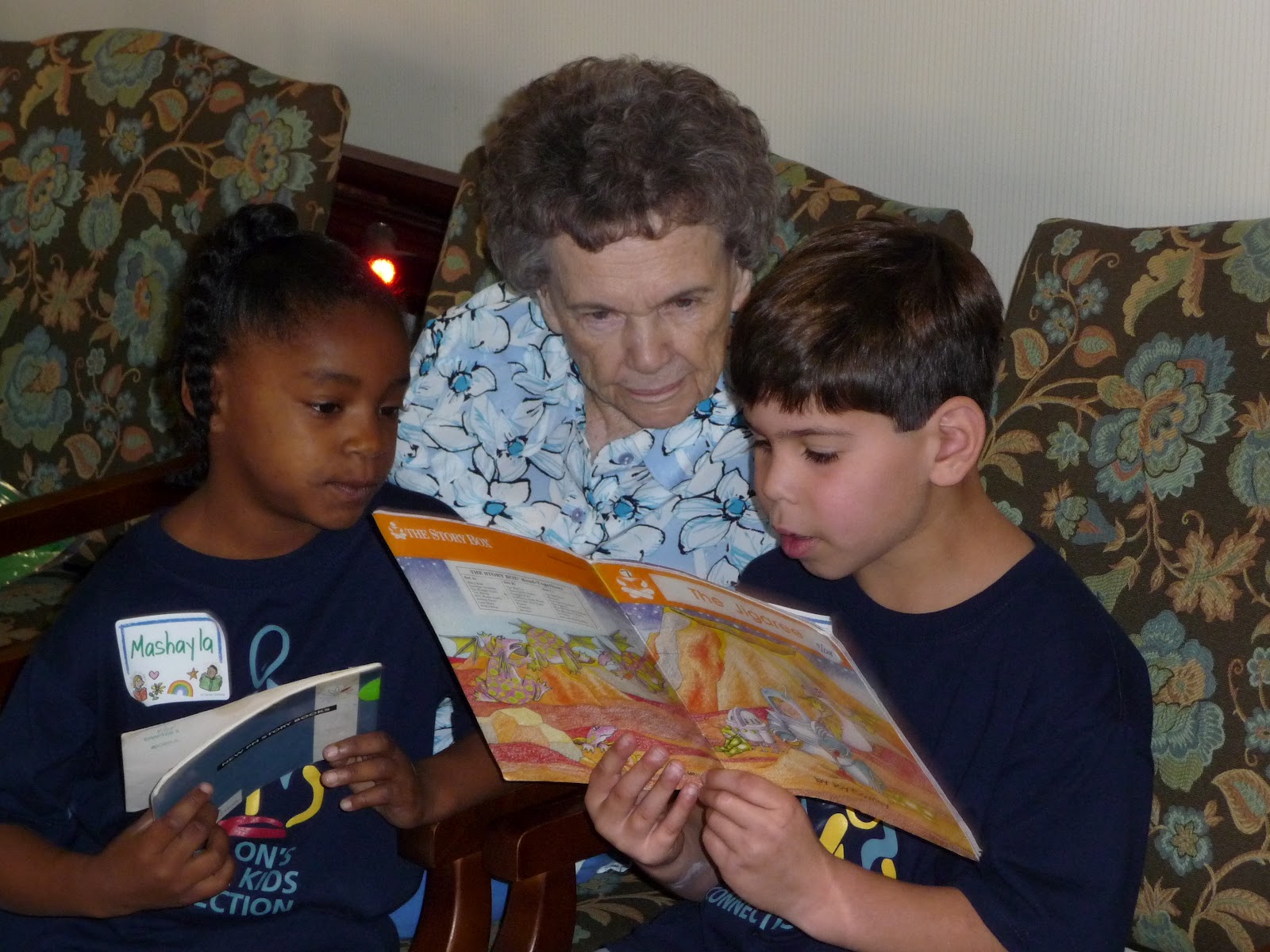
IN TEST: Eskaton is testing the agelessness of happiness. Separate groups of memory care residents and first-graders will be sharing their creative, artistic interpretations of happiness through a series of guided workshops. Tilted In the Mind of the Beholder™, the resulting artwork will become an intergenerational exhibition created to demonstrate that basic human desires -- such as happiness, among others -- transcend age and life experiences.


Tuesday, September 4, 2012

THINK WORDLY. SERVE LOCALLY.

THINK WORDLY. SERVE LOCALLY. A quick way to burn through your highlighting pen is to download and peruse the World Economic Forum’s remarkable compilation of essays, Global Population Ageing: Peril or Promise?
 
The report’s “Introduction” makes a compelling case for giving priority to aging issues, and for absorbing the wealth of knowledge bound within. “In an historical context, population ageing is one of the most remarkable human success stories of any era, reflecting contributions of public health, medicine, education and economic development. But capturing and unlocking the full benefits of that success require that we adapt our perspectives and reform our institutions. The good news is that there is a wide range of behavioural changes and public policy responses to population ageing that would simultaneously avoid a significant dampening of economic growth and enhance the quality of life for people reaching older ages today and for generations to come.”
 
Eskaton’s approach to “think worldly, serve locally” has generated several contributions to the international dialogue on aging. The organization’s identity as a progressive aging-services provider is well-known throughout its service areas in Northern California, and even across the United States. The extent to which the brand reputation reaches around the world is both inspiring and humbling, as well.
 
This spring a 12-person delegation of South Korea government officials toured The Parkview, the Eskaton-managed assisted living and memory care community in Pleasanton, California. The research and advisory team was led by Lee Moo-Seung, president of the Social Welfare Foundation or, as his business card stated, “Director, Old Man’s Specialty Recuperation Facility.”
 
Australia frequently sends contingents to California to tour Eskaton’s communities and the National Demonstration Home in Roseville, and to meet with various executives and practitioners. The next walkabout is slated for next month.
 
Global demand continues for Longevity Rules, the book published by Eskaton in 2011. Recent requests for the compendium of provocative essays on aging have come from groups of retirement facilitators in Paris and Munich, as well as the Legislative Library of Support Services in Saskatchewan, Canada. Conveners of the United Nations Conference on Aging and Technology in Geneva also shared the text with participants. Notably, two of the book’s authors Laura Carstensen and S. Jay Olshansky also contributed multiple essays to Global Population Ageing.
 
Eskaton’s Longevity Rules blog posts (www.longevityrules.blogspot.com) and Twitter feeds (https://twitter.com/longevityrules) are trending worldwide -- most recently attracting the United Nations Committee on Aging as a follower.
 
And of course the international media coverage was overwhelmingly positive for the Eskaton “Thrill of a Lifetime” for Mino Ohye earlier this year, which reunited our West Sacramento resident with his brother in Japan from whom he was separated for six decades.

Tuesday, March 6, 2012

LONGEVITY IS A NATURAL RESOURCE WORTH “EXPLOITING.”

LONGEVITY IS A NATURAL RESOURCE WORTH “EXPLOITING.” Eskaton’s commitment to natural resources includes energy efficiency, ridesharing, recycling and waste management. But, undoubtedly, the most respected natural resource within Eskaton’s 30 communities is our resident population -- the 3,500 older adults with energy, time and wisdom to spare.

Longevity truly is a rare asset, one worth conserving and “exploiting.” It has the capacity to fuel the economic engine, concentrate brainpower on innovation, add stability in unstable times, and provide safety in numbers (at a rate of 10,000 people turning 65 every day.)

“The shame is that we’re only looking at the problems,” said Laura Carstensen, director of the Stanford Center on Longevity in a recent interview with the Stanford Report. When, in fact, she reminds us, “the number of older people in the world is the only natural resource that’s actually growing.”

Carstensen is among a handful of authorities on longevity who gives applicable context to facts and numbers, rather than simply reporting them for dramatic effect. And, more importantly, she focuses on solutions rather than problems. For example, with respect to “retirement,” she makes the case in the SR interview that “money from 40 years of work can’t fund 30 years of retirement.” Instead, she proposes to spread out work for more years, cut the number of working days per week and the hours worked per day, and to integrate more sabbaticals into working schedules to give more time to other obligations.

This exemplifies the transformative thinking that values older adults and longevity as a natural resource, and as a benefit rather than a burden. Science, government and too many people associate age with decline. When instead we should appreciate that with age comes knowledge, experience, perspective and contextual thinking; as well as emotional stability and purposeful engagement.

Eskaton’s residents exploit their resourcefulness daily through volunteerism, mentoring and “encore careers.” It’s inspiring to witness, though they would claim it’s only natural.